
Farming
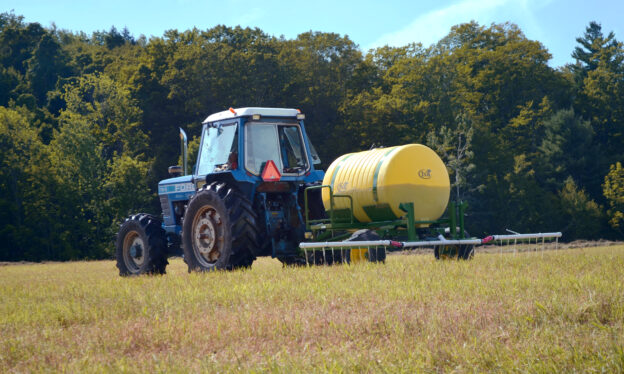
Urine is a sustainable, local alternative to commonly-used synthetic fertilizers.
Fertilizing with urine: is it safe? →
Does it work?

The urine produced by an adult human in one day contains sufficient nitrogen and phosphorus fertilizer to grow 400 grams of wheat–enough to bake a whole loaf of bread!
Human waste is rich in the same nutrients that plants need to thrive, including nitrogen, phosphorus, and potassium. Just like animal manure, human waste can be sanitized and transformed into natural, sustainably-produced fertilizer for use on agricultural soils.
Urine contains most of the fertilizer found in human waste, containing 80-85% of the nitrogen and 66% of the phosphorus that we flush away each day. Urine also wins from a public health perspective. The diseases associated with poor sanitation are fecal pathogens, while urine is generally free of pathogens and easily sanitized.
Nitrogen
Most farms in the US use synthetic nitrogen fertilizer, which is manufactured through an industrial process that consumes up to 2% of the world’s energy and emits vast amounts of carbon dioxide. Volatility in global energy prices have led to global fertilizer shortages, “driving farmers to desperation and threatening food supplies” according to the New York Times. Alternatively, farmers who wish to take a more ecological approach to agriculture are faced with limited options, including chilean nitrate, blood meal, bone meal, dried chicken manure, soy meal, or alfalfa meal. Each of these can require farmers to import nutrients from distant locales, have adverse environmental effects, exist in limited supply, and are more expensive than synthetic fertilizer. In contrast, urine is a locally available renewable resource that can be quite affordable for farmers. See the economy page for more information on how this works.
Phosphorus
Farming is impossible without phosphorus, which is essential to all life. The mined rock phosphate used to make fertilizer is a non-renewable resource, and high-quality reserves are gradually and steadily being depleted. According to the New Yorker, “some researchers say that ‘peak phosphorus,’ the point at which the amount of phosphorus being pulled from the ground starts to decline, could be reached within the next decade.” (This mineral is the source of synthetic phosphate fertilizer, and also the powdered rock phosphate used in organic agriculture.) But the good news is that urine is rich in phosphorus, and by using urine as a fertilizer this limited resource can be recycled indefinitely to grow new crops.
Micronutrients
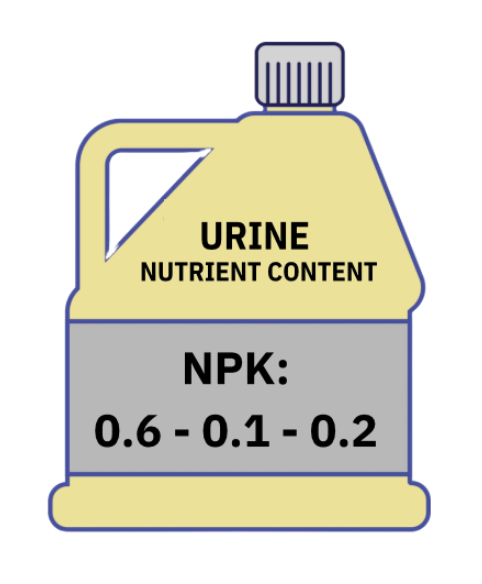
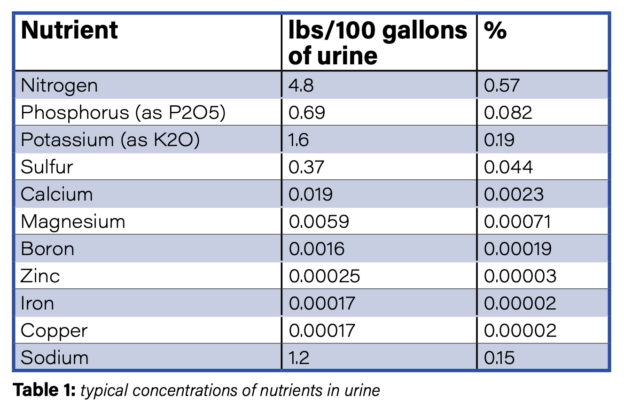
Urine also contains a wide range of micronutrients important for plant growth that are not present in most commercially available fertilizers. A breakdown of these from a typical sample of urine in Rich Earth’s urine collection program is included below:
Farmer Guide to Fertilizing with Urine
Rich Earth Institute’s Farmer Guide to Fertilizing with Urine summarizes our extensive research with farmer-partners in Southern Vermont, along with insights from the global research community. Our research has included controlled hay trials and qualitative trials with hemp, sweet corn, figs, cut flowers, and nursery trees. All farmer-partners reported observations indicating positive results from their experiments, with either comparable or better yields and/or robustness from their urine treated plants.
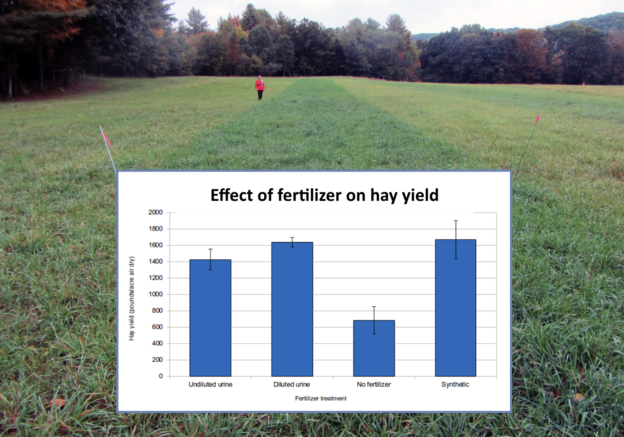
Rich Earth’s multi-year controlled trials found no significant difference between hay yields when using urine fertilizer or synthetic fertilizer to grow second cut hay.
Fairwinds Farm was Rich Earth’s first farm partner, and has been fertilizing their hay field with urine for the past 11 years, as a supplement to their use of manure. Jay Bailey believes the urine has increased hay yields considerably, enabling a second cutting without depleting soil nutrients. “Putting [urine] on a healthy field that has good strong plants in it, you can increase your yield, vastly. [It allows you to] take significantly greater volume of feed off the field…without taking away from the health of the plants.” Bailey also believes that, over time, continuing to feed the plants with urine will likely increase the nutrient bank in the soil because “with the urine, if it’s producing more top growth, it’s probably also producing more root growth, and that’s what would change the soil.”